
Value-Added Product Plants
Where the margin is. Lines designed around yield, texture consistency and a hygiene regime that survives audit.
Value-Added Product Plants
Paneer, ghee, curd, cheese and dessert plants
Overview
Liquid milk pays the overheads; value-added products pay the return. But every one of these products is a different engineering problem. Paneer is a yield and texture problem. Ghee is a thermal and free fatty acid problem. Curd is an incubation uniformity and cold chain problem. Cheese is a make-room and ripening problem.
We design each line against the specific product specification you intend to sell, not a generic dairy template. That means fixing the target fat and moisture, the coagulation regime, the press cycle, the chilling curve and the packing format before any equipment is sized.
Product lines are laid out with hygienic zoning so that raw handling, thermal processing, post-pasteurisation handling and packing are physically separated, with air, drainage and personnel flow designed to stop cross-contamination. This is what turns an FSSAI inspection or a customer audit from an event into a formality.
What’s included
Product specification workshop
We fix the sellable specification first: fat, moisture, texture, shelf life and packing format, and design the process backwards from it.
Yield and mass balance
Product-wise yield modelling against your milk composition, so that the plant's economics are known before capital is committed.
Line design
Coagulation, pressing, cooking, incubation, churning or clarification steps sized to batch and shift plan, with changeover and cleaning time built into the capacity calculation.
Hygienic zoning
Separation of raw, process and packing zones with air handling, drainage, personnel routes and material flow designed to prevent post-process contamination.
Cold chain
Blast chilling, cold room and dispatch sizing matched to production peaks rather than daily averages.
Trials and standardisation
Production trials to lock the recipe and process parameters, followed by written standard operating procedures your team can actually run.
Typical capacity range
| Capacity | Typical configuration | Notes |
|---|---|---|
| Paneer: 200 to 5,000 kg per day | Batch vat or continuous coagulation line | Yield typically 16 to 18 per cent on standardised buffalo milk, subject to composition and press regime. |
| Ghee: 200 to 10,000 kg per day | Butter melting or cream route ghee boiler | Batch or continuous, with clarification, settling and controlled granulation. |
| Curd, lassi, buttermilk: 1,000 to 50,000 litres per day | Cup, pouch or bottle filling with incubation room | Set or stirred curd, with incubation control and blast chilling sized to batch peak. |
Process flow
The sequence we design and commission against. Each stage carries its own specification, and nothing downstream is sized until the stage before it is fixed.
- 01Standardised milkFat and SNF fixed to product spec
- 02Heat treatmentProduct-specific time and temperature
- 03ConversionCoagulation, culturing or churning
- 04SeparationWhey drainage or clarification
- 05FormingPressing, moulding or granulation
- 06ChillingBlast chilling to core temperature
- 07PackingVacuum, cup or jar filling
- 08Cold storeDispatch-ready holding
- Standardised milk: Fat and SNF fixed to product spec
- Heat treatment: Product-specific time and temperature
- Conversion: Coagulation, culturing or churning
- Separation: Whey drainage or clarification
- Forming: Pressing, moulding or granulation
- Chilling: Blast chilling to core temperature
- Packing: Vacuum, cup or jar filling
- Cold store: Dispatch-ready holding
Design basis
Every value-added product is a different engineering problem. These are the parameters each line is designed and then standardised around during production trials.
| Parameter | Design value | Why it matters |
|---|---|---|
| Paneer coagulation temperature | 70 – 75 °C | Higher gives firmer body, lower gives higher moisture and yield |
| Paneer coagulant | Citric or lactic acid to pH 5.3 – 5.5 | Solution strength 1 – 2 %, added under controlled agitation |
| Paneer pressing | 2 – 3 kg/cm² for 15 – 30 min | Cycle locked during trials, then written into the SOP |
| Paneer yield | 16 – 18 % buffalo, 13 – 15 % cow | On standardised milk. Modelled against your actual analysis |
| Paneer chilling | Core ≤ 5 °C within 2 h | Blast chilling sized on batch peak, not daily average |
| Ghee clarification | 110 – 120 °C | Butter route gives tighter free fatty acid control than the cream route |
| Ghee moisture | ≤ 0.3 % | Granulation and settling before packing |
| Ghee free fatty acid | Premium grades below 1.4 % as oleic | [VERIFY] Confirm the current FSSAI ceiling with your QA before publishing a limit |
| Curd inoculation | 42 – 43 °C thermophilic | 22 – 25 °C for mesophilic cultures |
| Curd incubation endpoint | pH 4.5 – 4.6 | Uniform incubation room temperature matters more than the culture |
| Fermented product chilling | Blast to ≤ 5 °C | Pulls cups through the critical zone quickly after incubation |
These are standard design ranges, not project guarantees. Every figure is confirmed against your milk analysis, product specification and site conditions before it enters a DPR.
Utility requirements
Typical design basis. Utilities are sized from the process duty curve with diversity applied, so they are neither starved at peak nor oversized for the sake of it.
Steam
60 – 110 kg per 1,000 L milk converted
Value-added lines are far more steam-intensive than liquid milk
Refrigeration
Sized on blast chilling peak
Not on cold room holding load, which is the common error
Water
2.5 – 4.0 L per L of milk
Whey handling and higher changeover CIP frequency
Cold storage
Peak production plus longest dispatch gap
Plus a margin for festival demand
Equipment we specify
Paneer
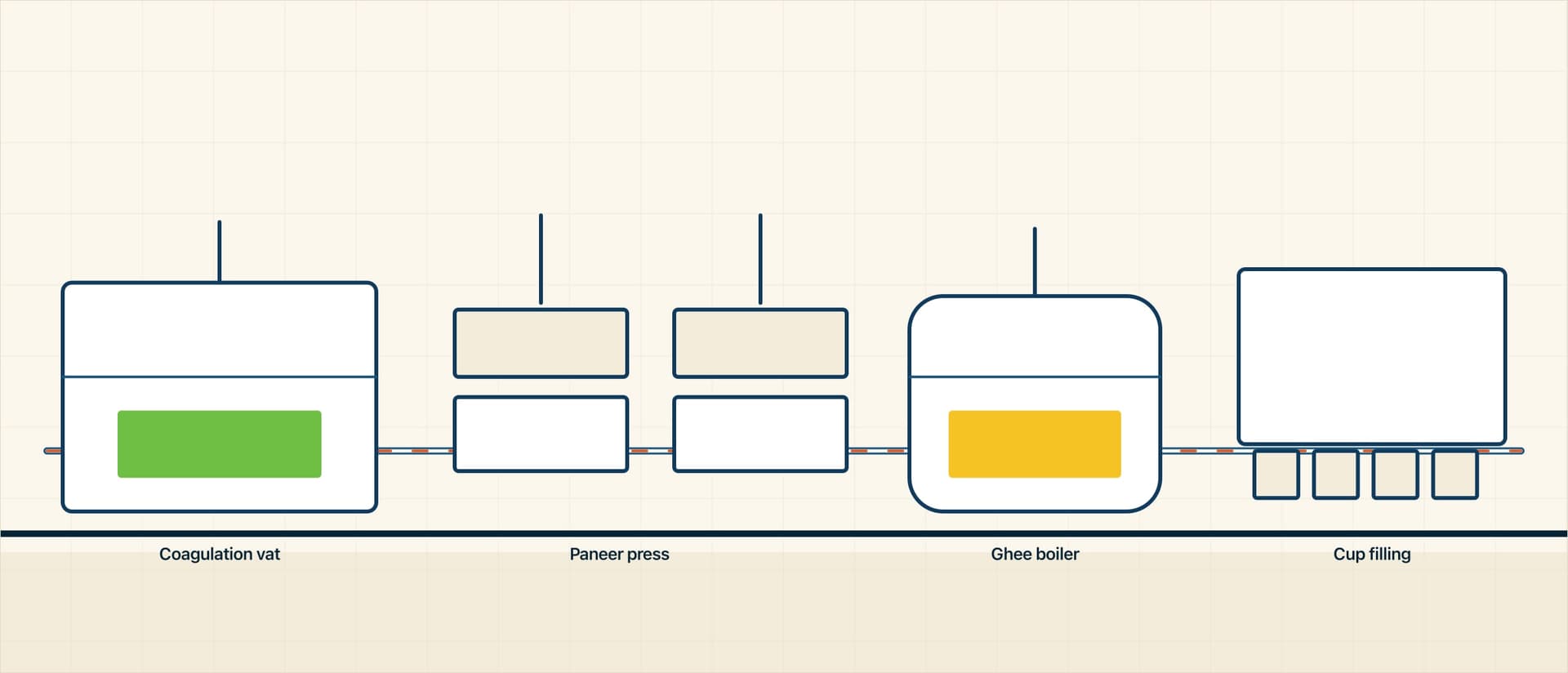
- Jacketed coagulation vat with agitator and hot water circulation
- Pneumatic or hydraulic paneer press with trolley system
- Chilling tank and block cutting table
- Vacuum packing machine with metal detector
Ghee
- Butter melting vat and ghee boiler with steam jacket
- Ghee clarifier and settling tank
- Granulation and crystallisation tank with slow agitation
- Jar, pouch and tin filling with nitrogen flushing option
Fermented and frozen
- Culture preparation and inoculation tank
- Incubation room with uniform temperature control
- Cup and pouch fillers with lidding and coding
- Ice cream ageing vat, continuous freezer and hardening tunnel
Standards & compliance
Product standards
Each product is designed to the compositional standard it will be sold against, so the specification is fixed before any equipment is sized. [VERIFY] Confirm current FSSAI compositional limits per product with your QA.
Hygienic zoning
Raw handling, thermal processing, post-process handling and packing physically separated, with air, drainage and personnel flow designed to stop post-process contamination.
Allergen and traceability
Where a site handles more than one product stream, segregation and changeover cleaning are formalised, with batch traceability from milk intake to finished pack.
Shelf-life validation
Claimed shelf life is established by storage trials under the client's own cold chain conditions, not copied from a supplier's brochure.
Regulatory limits and standard numbers are confirmed against the current published text for your product and licence category at DPR stage.
Frequently asked
On standardised buffalo milk, 16 to 18 per cent by weight is a realistic working range, and on cow milk closer to 13 to 15 per cent. Yield moves with milk composition, coagulation temperature and acidity, press pressure and cycle, and how much moisture your buyers accept. We model it against your actual milk analysis rather than a textbook figure.
The butter route gives better control of free fatty acid and a more consistent granular texture, and it lets you buy or store butter and decouple ghee production from the milk curve. The cream route has lower capital cost and fewer steps but tighter operating discipline. The choice usually follows whether ghee is your headline product or a by-product outlet for surplus fat.
Size against the peak, not the average. Curd needs blast chilling capacity to pull cups through the critical zone quickly after incubation, then holding volume for at least the longest dispatch gap in your week, usually two to three days of production plus a safety margin for festival demand.
Often yes, and it is usually the cheapest way to start. What has to be checked is the shift plan: value-added products need the pasteuriser at times that may collide with the liquid milk run, and each changeover costs a CIP cycle. We work that into the capacity calculation before recommending a dedicated stream.
Planning a value-added product plants project?
Send us the capacity, the product basket and the site location. We will tell you what the engineering actually involves before anyone quotes you for equipment.