Membrane Filtration Plants
MF, UF, NF and RO lines for protein concentrates, whey pre-concentration and water recovery, sized from a trial on your own feed.
Membrane Filtration Plants
Membrane filtration plants for milk and whey proteins
Overview
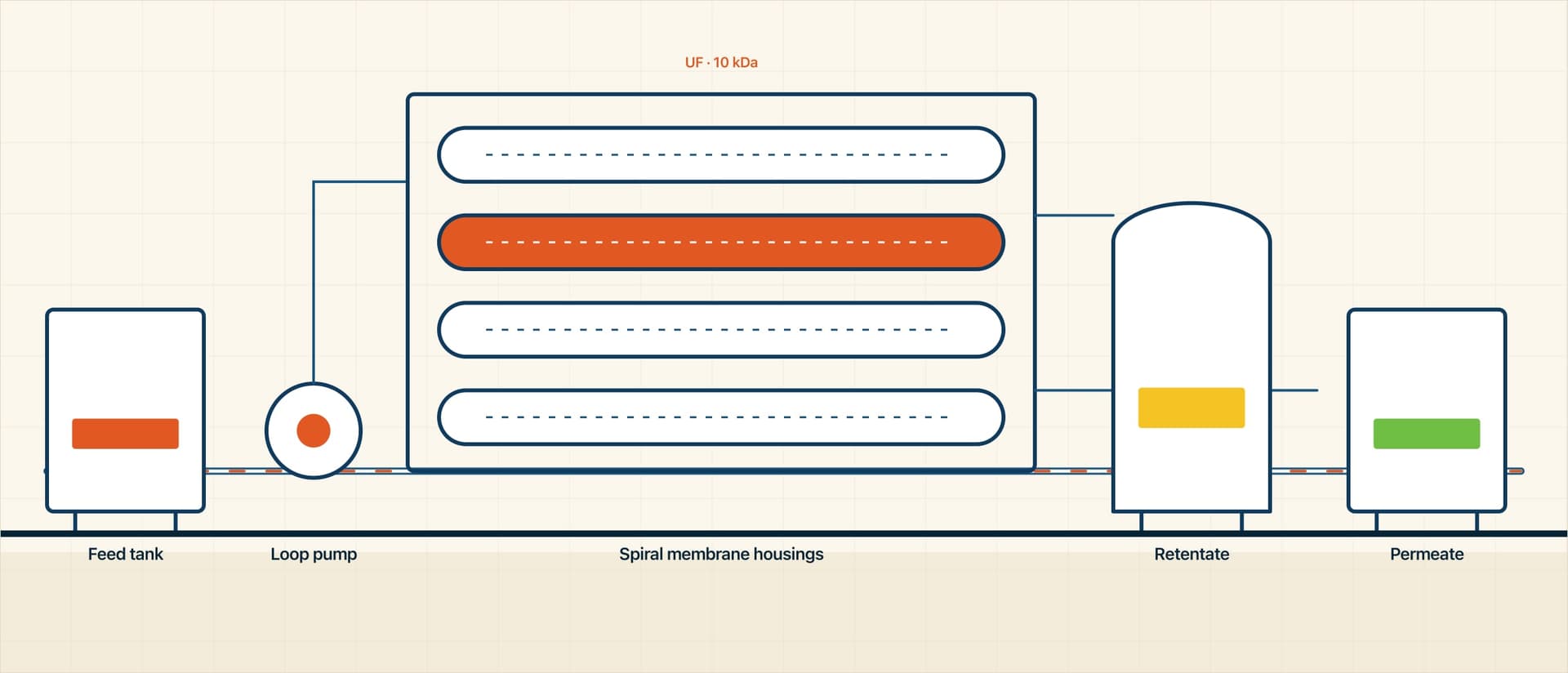
Membrane filtration separates milk and whey by molecular size under pressure, without heat. The same principle, at four pore sizes, does four different jobs: microfiltration removes bacteria and fat or splits casein from serum protein, ultrafiltration concentrates protein, nanofiltration removes water and monovalent salts, and reverse osmosis removes water alone.
For a dairy with a whey stream from paneer, cheese or chhena, this is the difference between an effluent load and a saleable product. Ultrafiltration with diafiltration turns sweet whey into WPC, and a microfiltration step ahead of it takes the same line to WPI. On the milk side, ultrafiltration of skim milk gives MPC and MPI.
Membrane plants are sized on flux, and flux depends on the feed: its temperature, its fat and fines, its pH and how it was heat treated. We do not size a plant from a catalogue flux figure. We run a trial on your own milk or whey first and design the membrane area, the loop configuration and the cooling duty from what that trial measures.
The other half of the design is cleaning. Membranes foul every run, and a membrane that is cleaned too gently loses flux while one cleaned too hard loses its life. We design the CIP for the membrane chemistry you are buying and record flux recovery after every clean, so decline is caught before it becomes a replacement.
What’s included
Feed and product definition
Milk or whey analysis, target product and its protein basis, daily volume and seasonality, and what happens to the permeate. Everything downstream is sized from this.
Pilot trial
Flux, rejection and concentration factor measured on your own feed, at the temperature and pressure the plant will run at, before membrane area is fixed.
Membrane and loop design
Selection of membrane type and material, staging and number of loops, feed-and-bleed or batch operation, diafiltration water and loop cooling duty.
Pre-treatment and finishing
Clarification, fat and fines removal and heat treatment ahead of the membranes, and the connection to evaporation and spray drying where the product leaves as powder.
Membrane-safe CIP
A dedicated CIP designed to the chemical, pH and temperature limits of the installed membranes, with flux recovery recorded after every clean.
Permeate recovery
Lactose-rich permeate routed to concentration or use rather than drain, and RO permeate polished for reuse as utility water where the quality allows.
Typical capacity range
| Capacity | Typical configuration | Notes |
|---|---|---|
| 2,000 to 5,000 L/h feed | Single UF or RO skid with its own CIP | Suited to whey from a paneer or chhena line, or a first WPC or MPC product. |
| 5,000 to 20,000 L/h feed | Multi-loop UF with diafiltration, RO pre-concentration | Whey from a mid-size cheese or paneer plant, with WPC or MPC dried on site. |
| 20,000 L/h feed and above | MF, UF and RO in series, fully automated | WPI and MPI lines, or whole-plant whey processing with permeate recovery. |
Process flow
The sequence we design and commission against. Each stage carries its own specification, and nothing downstream is sized until the stage before it is fixed.
- 01Feed definitionMilk or whey analysis, target product
- 02Pilot trialFlux and rejection on your feed
- 03Pre-treatmentClarification, fat and fines removal
- 04Heat treatmentPasteurise, cool to membrane temperature
- 05ConcentrationMF, UF, NF or RO to target solids
- 06DiafiltrationWater wash to lift protein purity
- 07FinishingEvaporation and spray drying
- 08CIP and recordsFlux recovery logged every clean
- Feed definition: Milk or whey analysis, target product
- Pilot trial: Flux and rejection on your feed
- Pre-treatment: Clarification, fat and fines removal
- Heat treatment: Pasteurise, cool to membrane temperature
- Concentration: MF, UF, NF or RO to target solids
- Diafiltration: Water wash to lift protein purity
- Finishing: Evaporation and spray drying
- CIP and records: Flux recovery logged every clean
Design basis
Membrane plants are sized from a trial on your own feed. These are the ranges that trial is designed around, and the figures a purchase specification should state.
| Parameter | Design value | Why it matters |
|---|---|---|
| Microfiltration pore size | 0.1 – 1.4 µm | 1.4 µm for bacteria removal, 0.1 µm to split casein from serum protein |
| Ultrafiltration cut-off | 5 – 10 kDa | Retains protein, passes lactose and minerals |
| Operating temperature | 10 – 12 °C or 45 – 50 °C | Cold limits bacterial growth, warm gives higher flux; chosen per product and run length |
| Transmembrane pressure, UF | 1 – 5 bar | Controlled per loop, not set once at commissioning |
| Operating pressure, RO | Up to 40 bar | Sets pump, housing and pipework pressure rating |
| RO whey pre-concentration | 18 – 24 % total solids | The economic hand-over point to the evaporator is calculated per plant |
| WPC protein, dry basis | 35 – 80 % | Above about 60 % needs diafiltration |
| WPI protein, dry basis | ≥ 90 % | Microfiltration ahead of UF to remove residual fat |
| MPC and MPI protein, dry basis | 42 – 90 % | Grade set by the buyer's specification |
| Flux recovery after CIP | Logged every clean | Normalised for temperature and pressure so decline is visible early |
These are standard design ranges, not project guarantees. Every figure is confirmed against your milk analysis, product specification and site conditions before it enters a DPR.
Utility requirements
Typical design basis. Utilities are sized from the process duty curve with diversity applied, so they are neither starved at peak nor oversized for the sake of it.
Electricity
Loop and high-pressure pumps
The dominant utility; variable speed drives on every loop
Cooling
Chilled water to loop coolers
Pumping heats the product, so cooling is sized on pump duty
Diafiltration water
RO-quality, at process temperature
Often supplied from the plant's own RO permeate after polishing
CIP
Dedicated membrane CIP
Chemicals, pH and temperature held to the membrane supplier's limits
Equipment we specify
Membrane systems
- Ceramic microfiltration for bacteria removal and protein fractionation
- Spiral-wound ultrafiltration for WPC, WPI, MPC and MPI
- Nanofiltration for whey demineralisation and concentration
- Reverse osmosis for whey pre-concentration and water recovery
Process ancillaries
- Feed balance tank, strainers and bag filters
- Clarifier or separator for fat and fines removal
- Plate heat exchangers for heat treatment and loop cooling
- Feed and high-pressure loop pumps on variable speed drives
Controls and instrumentation
- Flow, pressure and transmembrane pressure control per loop
- Inline density or refractometer for concentration end-point
- Conductivity and temperature on CIP supply and return
- Normalised flux trending to track fouling and membrane life
Standards & compliance
Trial before design
Membrane area, loop count and cooling duty are fixed from flux and rejection measured on your own feed, not from a catalogue figure.
Food-contact membranes and hygienic housings
Membrane elements and housings specified for dairy duty, with full-fit or sanitary spiral construction and drainable, crevice-free pipework around them.
Product standards
Protein basis and composition written against the buyer's specification and the applicable product standard. [VERIFY] Confirm the current FSSAI standard for each protein concentrate before launch.
Cleaning records
Every CIP cycle logged with time, temperature, conductivity and flux recovery, so membrane life and cleaning performance can be shown to an auditor.
Regulatory limits and standard numbers are confirmed against the current published text for your product and licence category at DPR stage.
Frequently asked
Yes. Flux on the same membrane can differ by a large margin between two dairies because of how the whey was produced and handled. A trial on your own feed is a small cost next to the membrane area and the cooling duty it decides.
Where whey is to be transported or dried, RO removes the first large volume of water at a fraction of the energy an evaporator needs, and an evaporator then finishes the job. The split point between the two is an economic calculation we do for your volumes and energy prices.
Protein content on a dry basis. A concentrate is made by ultrafiltration, with diafiltration to raise the protein further. An isolate needs a higher purity, which usually means additional diafiltration and, for WPI, a microfiltration step to take out residual fat. The product specification decides the line.
Polymeric spiral membranes in dairy duty are typically replaced every one to three years, and ceramic membranes last considerably longer. Life depends more on cleaning discipline than on anything else, which is why we record flux recovery after every CIP.
Planning a membrane filtration plants project?
Send us the capacity, the product basket and the site location. We will tell you what the engineering actually involves before anyone quotes you for equipment.