
Liquid Milk Processing Plants
Reception to pouch, sized on a real mass balance and built around a CIP circuit that actually cleans.
Liquid Milk Processing
Liquid milk processing plants engineered for shelf life
Overview
Liquid milk is a volume business with thin margins, so the engineering has to earn its keep in three places: regeneration efficiency at the pasteuriser, standardisation accuracy on SNF and fat, and pouch weight control at the filler. We design around those three.
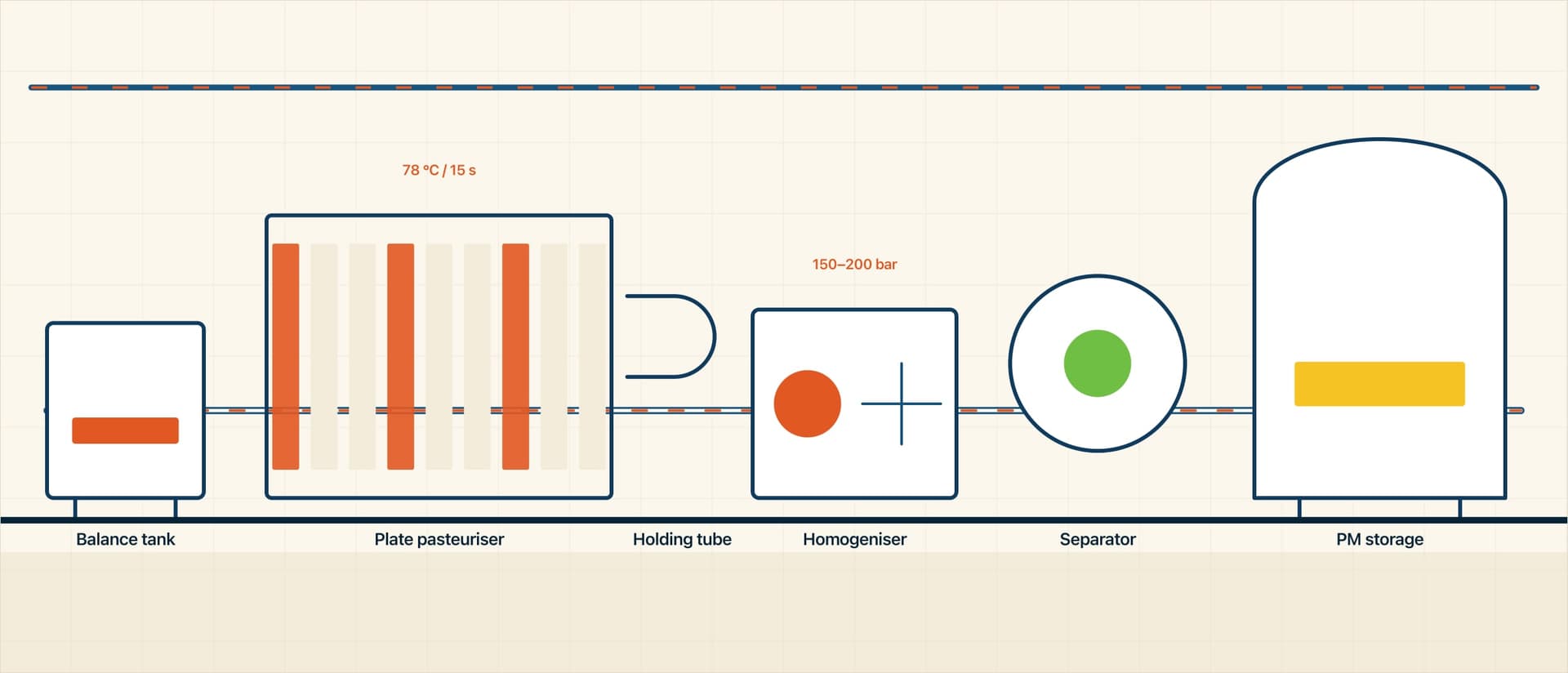
Our HTST specifications hold milk at 78 degrees Celsius for 15 seconds with a regeneration efficiency above 90 per cent, a flow diversion valve interlocked to holding tube outlet temperature, and a chart or electronic recorder on the legal control point. Homogenisation is specified at 150 to 200 bar in two stages depending on the product and packing format.
The CIP circuit is designed, not assumed. We calculate return flow velocities above 1.5 metres per second in every leg, size the return pump against the longest circuit, and lay out the piping so no dead leg exceeds three pipe diameters. This is the difference between a plant that holds MBRT and one that fights bacteriological rejections every summer.
What’s included
Reception and raw milk handling
Tanker unloading, air elimination, weighment or flow metering with totaliser, filtration, plate chilling to 4 degrees Celsius and insulated silo storage with agitation and level monitoring.
Standardisation and separation
Cream separator sizing, in-line or batch standardisation to target fat and SNF, and blending logic that holds the declared specification through the day's procurement variation.
HTST pasteurisation
Plate pasteuriser with regeneration, holding tube, flow diversion valve, hot water set, and the recording and interlocking arrangement required for legal compliance.
Homogenisation
Two-stage homogeniser sized to line capacity, positioned upstream or downstream of holding depending on product and packaging, with pressure control and safety interlocks.
Storage and packing
Insulated pasteurised milk storage tanks, filler feed arrangement, form-fill-seal pouch machines, crate handling, conveyors and cold room sizing against dispatch schedule.
CIP and effluent
Centralised CIP with acid, alkali, hot and cold water circuits, recovery tanks, and effluent load estimation feeding into ETP sizing.
Typical capacity range
| Capacity | Typical configuration | Notes |
|---|---|---|
| 5,000 to 25,000 LPD | Local brand or captive processing unit | Single pasteurisation stream, one or two pouch machines, manual CIP with recovery. |
| 25,000 to 1,00,000 LPD | Regional liquid milk dairy | Automated standardisation, semi-automatic CIP, multiple fillers and dedicated cold room. |
| 1,00,000 to 3,00,000 LPD | Federation or metro supply dairy | Parallel HTST streams, fully automated CIP, SCADA supervision and tanker dispatch bay. |
Process flow
The sequence we design and commission against. Each stage carries its own specification, and nothing downstream is sized until the stage before it is fixed.
- 01ReceptionWeighment, filtration, air elimination
- 02ChillingPlate chiller to 4 degrees Celsius
- 03Raw siloInsulated storage with agitation
- 04StandardisationFat and SNF correction
- 05Pasteurisation78 degrees for 15 seconds
- 06HomogenisationTwo-stage, 150 to 200 bar
- 07PM storageChilled pasteurised milk tanks
- 08Pouch packingFFS filling and crating
- Reception: Weighment, filtration, air elimination
- Chilling: Plate chiller to 4 degrees Celsius
- Raw silo: Insulated storage with agitation
- Standardisation: Fat and SNF correction
- Pasteurisation: 78 degrees for 15 seconds
- Homogenisation: Two-stage, 150 to 200 bar
- PM storage: Chilled pasteurised milk tanks
- Pouch packing: FFS filling and crating
Design basis
A liquid milk line lives or dies on three numbers: regeneration at the pasteuriser, standardisation accuracy, and CIP return velocity. These are the values we design and commission against.
| Parameter | Design value | Why it matters |
|---|---|---|
| Reception filtration | 100 – 200 micron duplex | Changeover without stopping the unloading pump |
| Chilling | To 4 °C | Plate chiller with chilled water and glycol sections |
| Standardisation tolerance | Fat ± 0.05 %, SNF ± 0.1 % | Holds the declared pack specification through daily procurement variation |
| Pasteurisation | 78 °C for 15 s | Holding tube sized to the legal residence time at maximum flow |
| Flow diversion valve | Interlocked to holding tube outlet RTD | Diverts on under-temperature, event recorded |
| Regeneration efficiency | ≥ 90 % | Every point given up is steam and chilling paid for daily |
| Homogenisation | 150 – 200 bar, two stage | Second stage typically 30 – 50 bar |
| Pasteurised milk storage | ≤ 6 °C to dispatch | Cold chain, not the pasteuriser, is the usual MBRT culprit |
| CIP alkali | 1.5 – 2.0 % NaOH at 75 – 80 °C | 20 – 30 min circulation, conductivity verified |
| CIP acid | 0.8 – 1.0 % HNO₃ at 65 – 70 °C | Frequency set by the milkstone load actually observed |
| Pouch fill accuracy | ± 5 mL on a 500 mL pack | Checked by weight at 30-minute intervals |
These are standard design ranges, not project guarantees. Every figure is confirmed against your milk analysis, product specification and site conditions before it enters a DPR.
Utility requirements
Typical design basis. Utilities are sized from the process duty curve with diversity applied, so they are neither starved at peak nor oversized for the sake of it.
Steam
20 – 30 kg per 1,000 L
For a liquid-milk-only line at ≥ 90 % regeneration
Chilled water
2 – 3 °C supply, 4 – 5 °C ΔT
Sized on simultaneous chilling and pasteuriser cooling duty
Electrical energy
12 – 20 kWh per 1,000 L
Homogeniser is the largest single motor load
Water
1.5 – 2.5 L per L of milk
Includes CIP make-up and floor washing
Equipment we specify
Thermal
- Plate heat exchanger pasteuriser, gasketed, with regeneration section
- Hot water set with steam injection and PID control
- Holding tube sized to legal residence time
- Plate chiller with chilled water and glycol sections
Mechanical
- Self-desludging cream separator
- Two-stage homogeniser with pressure gauges and safety valve
- Sanitary centrifugal and positive displacement pumps
- Pneumatic butterfly and mix-proof valves with position feedback
Storage and packing
- Insulated vertical or horizontal silos with CIP spray balls
- Form-fill-seal pouch machines with date coding
- Crate conveyors, roller tables and dispatch cold room
- Milk analyser and laboratory equipment for MBRT and platform tests
Standards & compliance
Statutory pasteurisation record
Holding tube outlet temperature and every flow diversion event are recorded and retained. The recorder is treated as a legal instrument and is calibrated on a documented schedule.
FSSAI hygiene schedule
Zoning, personnel flow, drainage and pest control designed against the hygiene and sanitary practices schedule for milk and milk products.
Microbiological verification
MBRT, standard plate count, coliform and phosphatase testing built into the commissioning protocol, with swab results closing out CIP validation.
Regulatory limits and standard numbers are confirmed against the current published text for your product and licence category at DPR stage.
Frequently asked
Above 90 per cent is the right target for a modern gasketed plate pasteuriser, and it is worth insisting on in the purchase specification. Each percentage point of regeneration you give up is steam and chilling load you pay for every single day the plant runs.
In most plants the cause is not the pasteuriser, it is the cold chain either side of it and the CIP. Chilling raw milk to 4 degrees Celsius within the shortest possible time of reception, holding pasteurised milk below 6 degrees Celsius through to dispatch, eliminating dead legs in the piping, and validating CIP return temperature and conductivity fixes the majority of cases.
For standard pouch milk, downstream of the regeneration section and upstream of holding gives good fat stability and lets you homogenise at pasteurisation temperature. If you are also packing a high-fat product on the same line, we size for the highest duty and place a bypass so low-fat runs do not pay the energy penalty.
Yes, but the buffer tank sizing and filler feed logic have to be designed for it at the outset. Bottle lines run at a different rate and need a different changeover and cleaning regime, so we size pasteurised milk storage to decouple the two rather than forcing the HTST to follow the filler.
Planning a liquid milk processing project?
Send us the capacity, the product basket and the site location. We will tell you what the engineering actually involves before anyone quotes you for equipment.