Dairy & Food Global Quality Excellence
We partner with dairy and food businesses to elevate quality systems, supplier assurance and food safety programmes from regional compliance to world-class international standards.
Global Quality Excellence
From regional compliance to world-class quality systems
Overview
Most plants meet the local regulator and stop there. The buyers who pay a premium, export markets, multinational brands and institutional customers, audit against a different bar: a certified food safety management system, approved suppliers, trained people and records that prove every batch was made the way the plan says.
We close that gap in the order it actually has to be closed. First a gap assessment against the standard you are aiming for, then the HACCP plan and the prerequisite GMP and GHP programmes it depends on, then the documentation, training and internal audits that keep the system running when we are not in the building.
Supplier assurance gets the same discipline. In dairy, food safety starts at the milk collection centre, so we build a risk-based approval and audit programme covering raw milk sources, ingredients, packaging and service providers, rather than a file of supplier certificates nobody reads.
Legal compliance stays in scope throughout: FSSAI licence conditions, product standards and labelling, and the export inspection requirements of the destination market. The deliverable is a plant that is ready for the certification body, the regulator and the buyer's auditor on the same day, and a team that can keep it that way.
What’s included
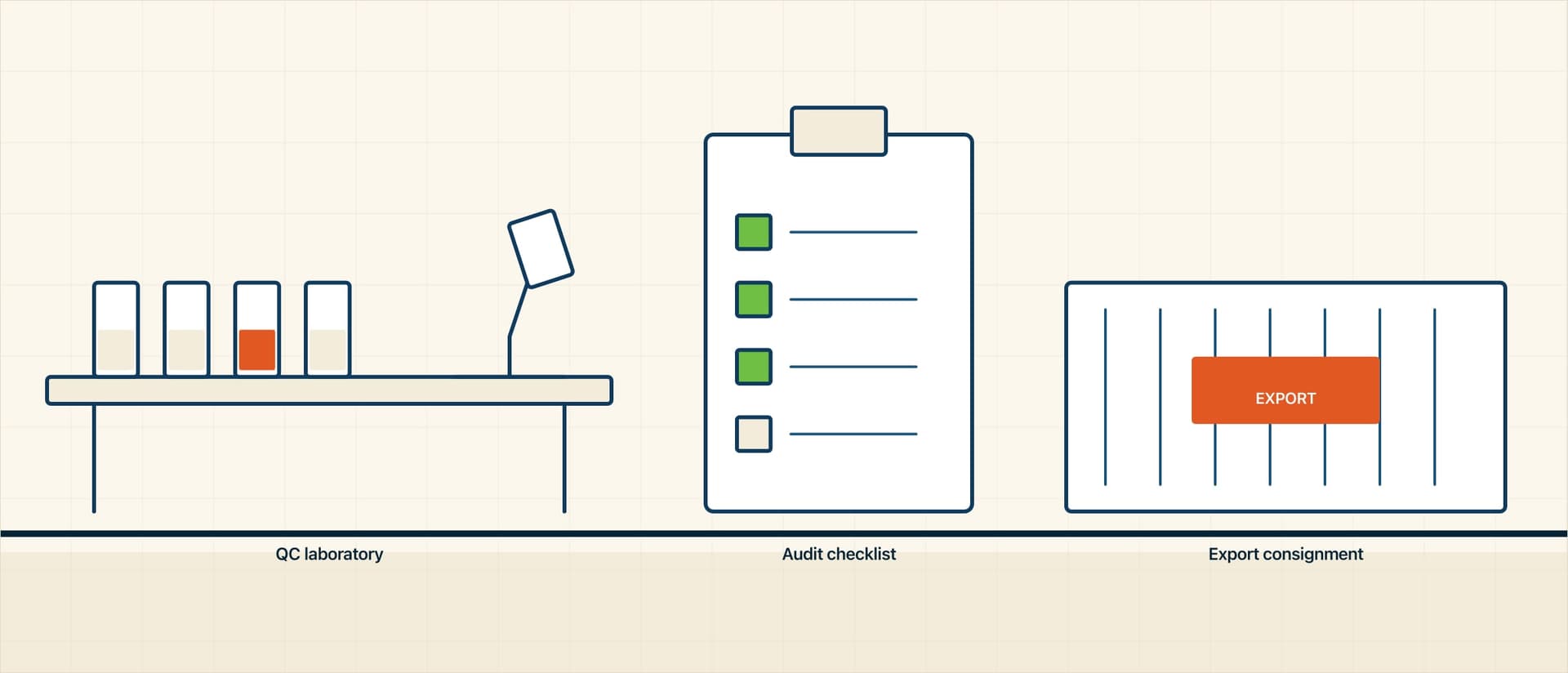
Pre-certification audit preparation
A gap assessment against the target standard, a corrective action plan with owners and deadlines, and a full mock audit before the certification body arrives, so the real audit holds no surprises.
HACCP development
Product-wise hazard analysis, critical control points with validated limits, monitoring, corrective action and verification procedures, built with your own team so they can defend it in an audit.
Internal and supplier audits
An internal audit programme covering the whole system, and risk-based approval and audits of raw milk sources, ingredient and packaging suppliers and service providers.
GMP and GHP programmes
The prerequisite programmes HACCP stands on: hygienic zoning, cleaning and sanitation, personal hygiene, pest control, water quality, allergen control, maintenance and calibration.
Food safety culture programmes
Leadership commitment, clear responsibilities, measured behaviour on the floor and a way to track improvement, which the major certification schemes now assess alongside the paperwork.
Documentation development
Food safety manual, policies, SOPs, work instructions and record formats, with document control, traceability and recall procedures written to match how the plant really runs.
Training for quality and production teams
Role-based training in HACCP, GMP and GHP, internal auditing and laboratory practice, with a training matrix and competency records an auditor can check.
RCA and CAPA support for quality claims
Root cause analysis of customer complaints, rejections and quality claims, with corrective and preventive actions that are verified as effective rather than simply closed.
Storage and distribution guidelines
Temperature, handling, stacking and shelf-life guidelines for warehouses, transport and distributors, so product quality holds after it leaves the plant.
Typical capacity range
| Capacity | Typical configuration | Notes |
|---|---|---|
| Gap assessment: 2 to 3 days on site | Current system against the target standard | A prioritised findings register and a realistic timeline to certification. |
| Certification readiness: typically 3 to 6 months | HACCP, prerequisite programmes, documentation, training and mock audit | The timeline depends on the starting point and on any fixes the building or equipment needs. |
| Ongoing quality partnership | Retained internal and supplier audits, training and system review | Keeps the system current through surveillance audits, new products and new suppliers. |
Process flow
The sequence we design and commission against. Each stage carries its own specification, and nothing downstream is sized until the stage before it is fixed.
- 01Gap assessmentCurrent system against target standard
- 02HACCP and PRPsHazard analysis, CCPs, GMP and GHP
- 03DocumentationManual, SOPs, records and control
- 04TrainingQuality and production teams
- 05Supplier assuranceApproval and risk-based audits
- 06Internal auditFull system audit and review
- 07Mock auditAgainst the certification standard
- 08CertificationSupport through the audit day
- Gap assessment: Current system against target standard
- HACCP and PRPs: Hazard analysis, CCPs, GMP and GHP
- Documentation: Manual, SOPs, records and control
- Training: Quality and production teams
- Supplier assurance: Approval and risk-based audits
- Internal audit: Full system audit and review
- Mock audit: Against the certification standard
- Certification: Support through the audit day
Design basis
A certification-ready system is measured against benchmarks like these. Where the plant falls short, the gap becomes a graded finding with an owner and a deadline.
| Parameter | Design value | Why it matters |
|---|---|---|
| HACCP plan review | At least annually, and on any change | New product, new equipment, new supplier or a deviation all trigger a review |
| Internal audit | Whole system at least annually | Higher-risk areas audited more often |
| Supplier approval | Risk-based, before first supply | High-risk suppliers audited, not approved on a certificate alone |
| Training | Role-based, with competency records | Attendance is not evidence of competence |
| Pasteurisation record | Every batch, no gaps | Checked against the controller log, not only the paper chart |
| Release instruments | Calibrated and traceable | Every thermometer, balance and analyser used for a release decision |
| Process water | Potable at point of use | [VERIFY] IS 10500 as referenced in FSSAI Schedule 4 |
| Traceability | Pack to raw milk within 4 hours | The mock recall standard most certification schemes test |
| Environmental monitoring | Zoned swab plan with trend review | Results that are filed but never trended do not count |
| Labelling and composition | Every declaration proven | [VERIFY] Current FSSAI product standards, FSS Labelling and Display and Legal Metrology rules |
These are standard design ranges, not project guarantees. Every figure is confirmed against your milk analysis, product specification and site conditions before it enters a DPR.
Utility requirements
Typical design basis. Utilities are sized from the process duty curve with diversity applied, so they are neither starved at peak nor oversized for the sake of it.
Food safety team
A named leader with authority
Certification schemes expect management ownership, not a consultant's
Plant access
Normal production shifts
A staged day tells us nothing useful
Records
Last 3 to 12 months
Production, QC, CIP, calibration, complaints and recalls
Laboratory
Independent and accredited
For statutory parameters, so results do not rely on the plant's own lab
Equipment we specify
Standards we work to
- FSSC 22000, BRCGS Food Safety and ISO 22000
- Codex HACCP principles
- FSSAI licence conditions, hygiene requirements and product standards
- Destination market and buyer-specific requirements for export
Typical findings
- Critical control point monitored but deviations not actioned
- Supplier approval based on certificates, never on an audit
- Release instruments out of calibration
- Training delivered but competence never checked
Outputs
- HACCP plan and prerequisite programme documents
- Food safety manual, SOPs and record formats
- Approved supplier register and supplier audit reports
- Training matrix, competency records and mock audit report
Standards & compliance
GFSI-benchmarked certification
Systems built to the requirements of FSSC 22000 and BRCGS Food Safety, or ISO 22000 where that is what the buyer asks for, with HACCP to Codex principles as the base.
Statutory
FSSAI licence conditions, hygiene and sanitary practices, product standards, contaminant and residue limits, and labelling and packaged commodity rules. [VERIFY] All references checked against current published text at the time of audit.
Export
Destination market requirements and export inspection approval where the destination requires it, confirmed for the specific market and product before work starts.
Independence
We are not a certification body and do not issue certificates, which lets us tell you what the certification body will find before it does.
Regulatory limits and standard numbers are confirmed against the current published text for your product and licence category at DPR stage.
Frequently asked
The one your buyers ask for. Export and multinational buyers usually require a GFSI-benchmarked scheme such as FSSC 22000 or BRCGS, while ISO 22000 or a HACCP certificate can satisfy many domestic customers. We confirm the requirement with the buyer before any work is planned around it.
Typically three to six months from the gap assessment. Plants with a working HACCP plan and clean records move faster; plants that need building or equipment changes take longer, and the gap assessment tells you which you are.
No. We are not a certification body and we do not issue certificates. We build and audit your system to the same requirements, so that when the certification body, the FSSAI inspector or the buyer's auditor arrives, the gaps have already been found and closed.
It is whether people follow the system when nobody is watching. The major certification schemes now expect a plant to show leadership commitment, clear responsibilities and measured improvement in behaviour, so it is designed and evidenced like any other part of the system.
Yes. Many findings are procedural and your team can close them. Where a finding needs engineering, such as a dead leg, a drainage fault or a missing record from the control system, we can design and supervise the fix.
Planning a global quality excellence project?
Send us the capacity, the product basket and the site location. We will tell you what the engineering actually involves before anyone quotes you for equipment.