Food, Fruit & Vegetable Processing
Seasonal, perishable and unforgiving on throughput. Lines designed for the crop window you actually have.
Food, Fruit & Vegetable
Fruit, vegetable and food processing lines
Overview
Fruit and vegetable processing runs on a different clock to dairy. The raw material arrives in a compressed season, degrades within hours of harvest, and varies far more in quality than milk does. A line that is right for mango in May can sit idle for eight months unless it is designed for a crop calendar rather than a single product.
We start from the crop calendar and the catchment: which crops, in what window, at what arrival rate and what quality spread. That determines line capacity, whether aseptic or hot-fill or frozen is the right route, and how much cold storage buffers the arrival peak.
Thermal design is then set by the product's acidity and target shelf life, from simple hot-fill for high-acid pulps to full sterilisation and aseptic filling for shelf-stable formats. Hygienic layout, allergen segregation and a documented cleaning regime are designed in, because export and institutional buyers audit for them.
What’s included
Crop calendar and capacity study
Which crops, in what window, at what daily arrival rate, and the resulting line capacity and utilisation across the year.
Process route selection
Aseptic, hot-fill, retort, IQF or dehydration selected against product acidity, target shelf life, distribution chain and buyer specification.
Line design
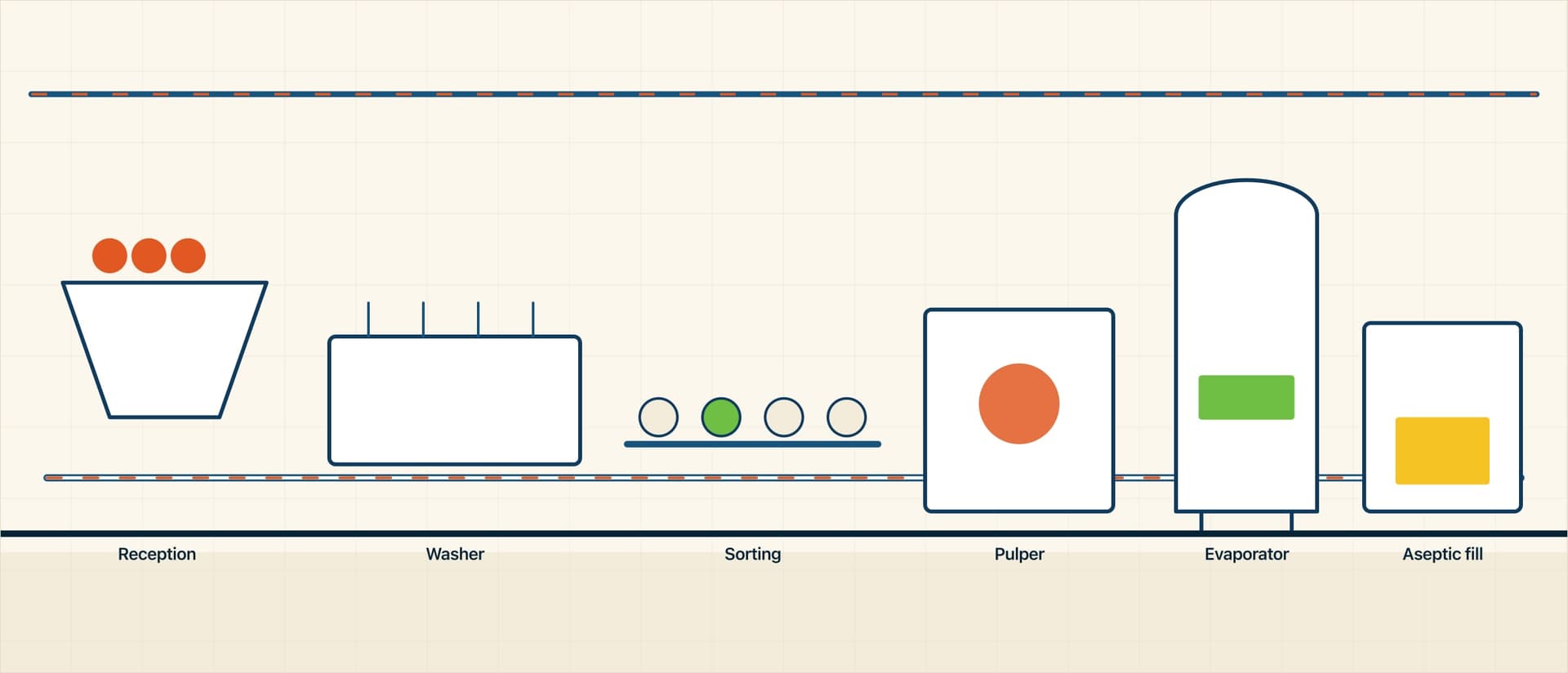
Reception, washing, sorting, blanching, pulping or cutting, refining, thermal treatment and filling, with material handling sized to peak arrival.
Hygienic and allergen layout
Zoning, drainage, air handling, personnel routing and allergen segregation designed to satisfy export and institutional buyer audits.
Cold storage and buffering
Raw material and finished goods cold storage sized to smooth the arrival peak and the dispatch schedule.
Commissioning and trials
Water trials, product trials across the quality spread of the incoming crop, and process parameter standardisation with written operating procedures.
Typical capacity range
| Capacity | Typical configuration | Notes |
|---|---|---|
| 1 to 5 tonnes per hour | Pulp, puree or sauce line | Seasonal operation with aseptic or hot-fill packing, sized to a single main crop plus a secondary. |
| 5 to 20 tonnes per hour | Multi-crop processing facility | Shared reception and washing with product-specific downstream sections and larger cold storage. |
| IQF and dehydration | Frozen or dried vegetable lines | Blanching, freezing or drying capacity matched to arrival rate and packing format. |
Process flow
The sequence we design and commission against. Each stage carries its own specification, and nothing downstream is sized until the stage before it is fixed.
- 01ReceptionWeighing and quality grading
- 02WashingSoak, spray and inspection
- 03SortingGrading and defect removal
- 04BlanchingEnzyme deactivation
- 05PulpingExtraction and refining
- 06ThermalConcentration or sterilisation
- 07FillingAseptic, hot-fill or freezing
- 08StorageAmbient or cold dispatch
- Reception: Weighing and quality grading
- Washing: Soak, spray and inspection
- Sorting: Grading and defect removal
- Blanching: Enzyme deactivation
- Pulping: Extraction and refining
- Thermal: Concentration or sterilisation
- Filling: Aseptic, hot-fill or freezing
- Storage: Ambient or cold dispatch
Design basis
Fruit and vegetable lines are designed from the crop calendar backwards. These parameters follow from the crop, its acidity and the shelf life the buyer requires.
| Parameter | Design value | Why it matters |
|---|---|---|
| Acidity threshold | pH 4.6 | Decides high-acid versus low-acid processing, and therefore the whole thermal design |
| Blanching | 90 – 95 °C for 2 – 5 min | Crop dependent, set by enzyme deactivation testing |
| Pulper screen | 0.5 – 1.5 mm | Interchangeable, selected per crop and target texture |
| Mango pulp solids | 14 – 16 °Brix natural | Concentrated to 28 – 30 °Brix where the buyer wants concentrate |
| Hot fill | ≥ 85 °C at fill, inverted hold | Suitable for high-acid products in shorter distribution chains |
| Aseptic processing | Sterilise, cool, fill sterile | Longer ambient shelf life and bulk formats industrial buyers prefer |
| IQF tunnel | −35 to −40 °C | Product core to ≤ −18 °C before packing |
| Raw material cold storage | 0 – 4 °C | Sized on arrival peak minus line throughput, in days |
| Finished frozen storage | −18 °C or below | With dock levellers and a defined loading discipline |
These are standard design ranges, not project guarantees. Every figure is confirmed against your milk analysis, product specification and site conditions before it enters a DPR.
Utility requirements
Typical design basis. Utilities are sized from the process duty curve with diversity applied, so they are neither starved at peak nor oversized for the sake of it.
Steam
Blanching, thermal treatment and evaporation
Evaporation dominates on concentrate lines
Water
3 – 6 L per kg of raw material
Washing and flume water, with recirculation and filtration
Refrigeration
Freezing capacity at arrival peak
Plus raw and finished cold storage holding load
Effluent
High organic load, seasonal
ETP sized for the season, not the annual average
Equipment we specify
Front end
- Tipping and reception hoppers with elevators
- Soak and spray washers with recirculation and filtration
- Roller or belt sorting tables with inspection lighting
- Destoner, deseeder and size grading equipment
Processing
- Steam or water blancher with residence control
- Pulper and finisher with interchangeable screens
- Tubular or scraped surface heat exchangers
- Evaporator for concentrate lines
Packing and storage
- Aseptic filler with bag-in-drum or bag-in-box
- Hot-fill bottling or pouch line with cooling tunnel
- IQF tunnel or spiral freezer
- Raw material and finished goods cold storage with dock levellers
Standards & compliance
Crop calendar as the design input
Which crops, in what window, at what daily arrival rate and quality spread. This sets line capacity before any equipment is considered.
Buyer and export audits
Hygienic zoning, allergen segregation, traceability and documented cleaning designed to satisfy institutional and export buyer audits from the first consignment.
Thermal process validation
The thermal process is validated for the actual product and pack format, with records retained, rather than adopted from a similar product.
Regulatory limits and standard numbers are confirmed against the current published text for your product and licence category at DPR stage.
Frequently asked
By designing the front end to be shared and the back end to be swappable. Reception, washing and sorting handle several crops with changed screens and settings, while the thermal and filling section is selected so that a second and third crop in different windows can use it. We set that out in the crop calendar study before the layout is fixed.
Aseptic gives longer ambient shelf life and larger bulk formats that industrial buyers prefer, at higher capital cost and much tighter operating discipline. Hot-fill is cheaper and simpler and works well for high-acid products going into shorter chains. The buyer's specification usually decides it.
Enough to absorb the difference between arrival rate at peak and line throughput, which in a mango season can be several days of intake. Undersizing this is the most common and most expensive mistake we see, because the alternative is rejecting fruit at the gate during the only weeks that matter.
Yes, and utilities usually share well, since steam, refrigeration and CIP are already there. What must not be shared casually is the hygienic zone and the drainage, and allergen segregation needs to be established formally if you are supplying audited buyers.
Planning a food, fruit & vegetable project?
Send us the capacity, the product basket and the site location. We will tell you what the engineering actually involves before anyone quotes you for equipment.