
Automation, PLC & SCADA
Automation that removes judgement calls from the night shift, and produces the records an auditor asks for.
Automation, PLC & SCADA
Dairy plant automation, PLC and SCADA
Overview
Automation in a dairy is not about removing operators. It is about removing the three or four decisions per shift where a tired human gets it wrong: a valve left in the wrong position, a CIP cycle cut short, a diversion not recorded, a batch not traceable back to the silo it came from.
We write the control philosophy before anyone selects hardware: the route matrix, the interlock table, the CIP sequence with its time, temperature and conductivity criteria, alarm classification, and exactly which records must be retained and for how long.
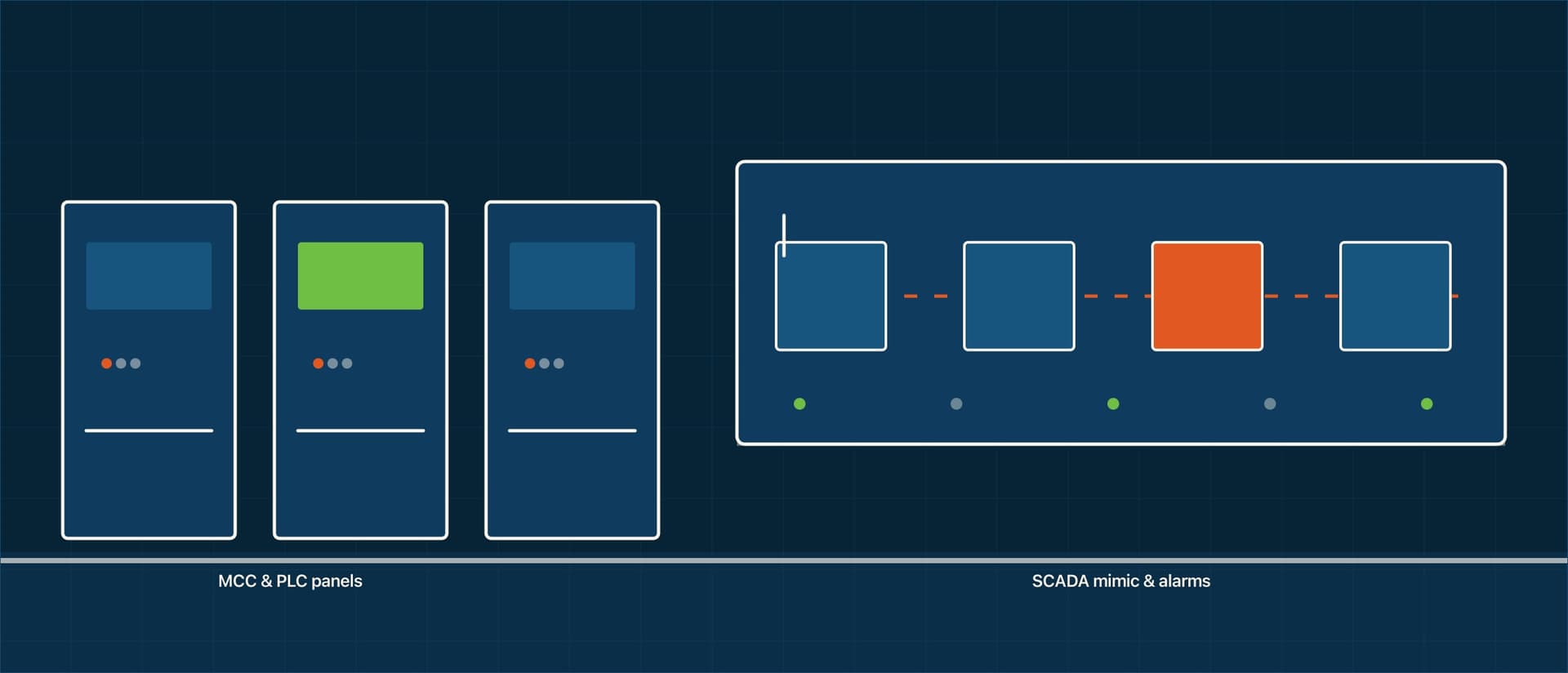
From that we produce the input and output schedule, panel and field instrument specification, and the SCADA screen design. Screens are built for the person running the plant at two in the morning, not for a demonstration: current route highlighted, active alarms visible without navigation, and every set point traceable to who changed it.
The system is validated on site against the interlock table line by line, with each interlock deliberately provoked and its response recorded, before the plant is allowed anywhere near product.
What’s included
Control philosophy
A written document covering operating modes, route matrix, interlocks, permissives, alarm classes, and the records the system must generate and retain.
Instrumentation design
Field instrument selection and placement for flow, temperature, pressure, level and conductivity, with the input and output schedule and cable schedule.
PLC programming
Structured, commented programming for route control, CIP sequencing, pasteuriser control with flow diversion, and recipe handling for value-added lines.
SCADA and HMI
Screen hierarchy designed for shift operation, live route display, alarm and event management, trends, and role-based access with audit trail.
Reporting and traceability
Batch reports, CIP validation reports, pasteurisation temperature records and silo-to-pouch traceability, exportable for FSSAI and customer audits.
Validation and training
Point-to-point checks, line-by-line interlock testing with recorded response, operator and maintenance training, and handover of source and backup.
Typical capacity range
| Capacity | Typical configuration | Notes |
|---|---|---|
| Standalone automation | CIP or pasteuriser control only | Single PLC with local HMI, ideal as a first step on an existing manual plant. |
| Plant-wide SCADA | Reception to packing supervision | Route control, CIP, thermal processing and utility monitoring under one supervisory system. |
| SCADA with reporting layer | Traceability and compliance records | Batch and CIP records retained and exportable, with role-based access and change audit trail. |
Process flow
The sequence we design and commission against. Each stage carries its own specification, and nothing downstream is sized until the stage before it is fixed.
- 01Control philosophyModes, routes, interlocks
- 02I/O scheduleInstrument and signal list
- 03Panel designLayout, protection, wiring
- 04PLC logicSequences and permissives
- 05SCADA screensOperator-first layout
- 06SimulationLogic tested off-plant
- 07Loop checksPoint-to-point verification
- 08ValidationInterlocks provoked and recorded
- Control philosophy: Modes, routes, interlocks
- I/O schedule: Instrument and signal list
- Panel design: Layout, protection, wiring
- PLC logic: Sequences and permissives
- SCADA screens: Operator-first layout
- Simulation: Logic tested off-plant
- Loop checks: Point-to-point verification
- Validation: Interlocks provoked and recorded
Design basis
Automation is specified from a written control philosophy, not from a hardware list. These are the parameters that philosophy fixes before anything is bought.
| Parameter | Design value | Why it matters |
|---|---|---|
| Pasteuriser control | PID on hot water circuit | Flow diversion interlocked to holding tube outlet RTD |
| Legal temperature sensor | ± 0.1 °C, calibrated | Calibration schedule and records defined at design stage |
| Recording interval | ≤ 1 min | For the statutory pasteurisation record |
| CIP validation criteria | Time, temperature and conductivity | All three logged per cycle, per circuit |
| Route interlocking | Cross-contaminating combinations not selectable | Enforced in logic, not by operator discipline |
| Alarm classification | Critical / high / warning | Time-stamped, with acknowledgement recorded against a user |
| Record retention | 12 months minimum | [VERIFY] Confirm against your buyers' audit requirements and FSSAI |
| Access control | Role-based with audit trail | Every set-point change traceable to a named user |
| Control network | Segregated, managed switching | Control traffic separated from office IT |
| Handover | Commented source and backups | You should never need the integrator to change your own plant |
These are standard design ranges, not project guarantees. Every figure is confirmed against your milk analysis, product specification and site conditions before it enters a DPR.
Utility requirements
Typical design basis. Utilities are sized from the process duty curve with diversity applied, so they are neither starved at peak nor oversized for the sake of it.
Panel environment
Ingress rating to the zone
Wash-down areas need a materially higher rating than the MCC room
UPS backing
PLC, HMI and critical instruments
So a supply dip does not lose a batch record
Instrument air
Clean, dry, oil-free at 6 bar
Valve actuation reliability follows air quality
Equipment we specify
Control hardware
- PLC with redundant power supply and remote input/output where the layout warrants it
- Motor control centre and field junction boxes to the plant's ingress rating
- Industrial HMI panels at reception, process and CIP stations
- Managed industrial ethernet switching with segregated control network
Field instruments
- Magnetic flow meters on milk and CIP return lines
- Sanitary RTDs on pasteuriser holding tube outlet and CIP return
- Conductivity transmitters for phase detection and CIP strength
- Radar or hydrostatic level transmitters on silos and CIP tanks
Software deliverables
- Commented PLC source code with a written function description
- SCADA project with screen hierarchy and alarm database
- Report templates for batch, CIP and pasteurisation records
- Backup, restore and disaster recovery procedure
Standards & compliance
Control philosophy first
Operating modes, route matrix, interlock table, alarm classes and record retention are written and signed off before hardware selection.
Validation by provocation
Every interlock is deliberately provoked on site and its response recorded, before the plant goes near product.
Audit-ready records
Batch reports, CIP validation records and pasteurisation temperature records exportable in a form an FSSAI inspector or a customer auditor will accept.
Platform selection
Chosen on local service availability and spares, not brand preference. If your team already knows a platform and can get an engineer to site within a day, that is usually the right answer.
Regulatory limits and standard numbers are confirmed against the current published text for your product and licence category at DPR stage.
Frequently asked
Usually the CIP is worth automating first, on its own. A validated CIP with recorded time, temperature and conductivity removes the single most common cause of bacteriological failure and pays back through reduced rework and rejection long before any labour saving is counted.
We work with the mainstream industrial platforms and select on the basis of local service availability and spares, not brand preference. If your maintenance team already knows a platform and can get an engineer to site within a day, that is usually the right choice.
At minimum, pasteurisation temperature and flow diversion events with time stamps, CIP cycle records with achieved temperature, conductivity and duration, batch identity linking silo to finished pack, and an audit trail of set-point changes with the user who made them. We define retention periods in the control philosophy.
Yes. Commented source, the SCADA project, the interlock table and the validation records are handed over as part of the deliverable. You should never be in a position where only your integrator can change your plant.
Planning a automation, plc & scada project?
Send us the capacity, the product basket and the site location. We will tell you what the engineering actually involves before anyone quotes you for equipment.