Milk Shed & Chilling Equipment
Quality is won or lost in the first two hours. We plan the network that gets milk cold before it moves.
Milk Shed & Chilling
Milk shed infrastructure and chilling networks
Overview
Every hour raw milk spends above 10 degrees Celsius costs you shelf life at the other end of the chain. Milk shed engineering is the discipline of removing those hours: placing chilling capacity close enough to the producer, sizing it for the flush season rather than the lean, and routing tankers so that no can waits for a full load.
We map the procurement geography first, plotting village level collection points and their expected volumes across flush and lean seasons, then locate bulk milk coolers and chilling centres against road time, power availability and pouring pattern.
The equipment specification follows from that map: BMC capacity, direct expansion or ice bank, back-up power, electronic milk analysers and weighing at the VLCC, and the data path that gets fat, SNF and quantity back to your accounting system the same day.
What’s included
Milk shed mapping
Village-wise volume assessment across flush and lean seasons, pouring pattern, road time to the nearest chilling point, and the growth assumption behind each location.
Chilling network plan
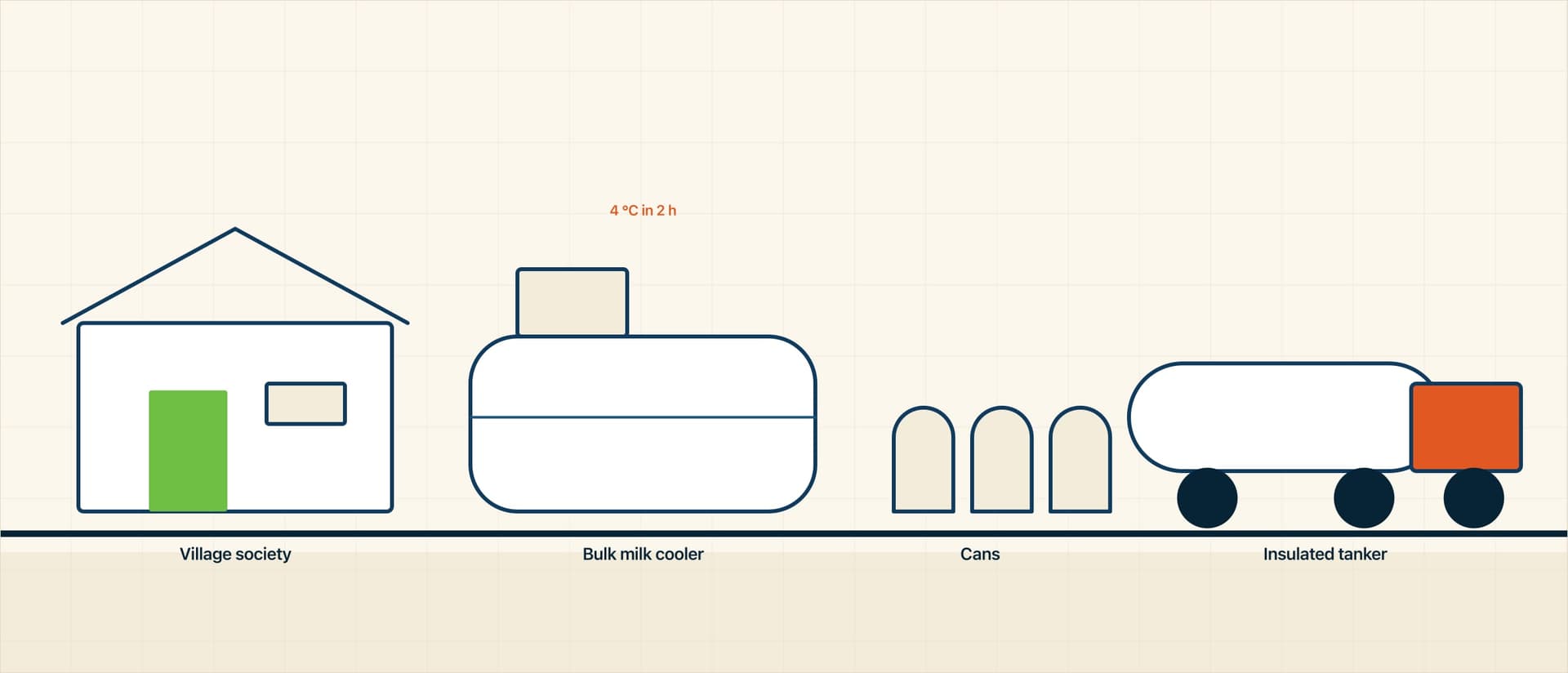
Placement and sizing of bulk milk coolers and chilling centres so that milk reaches 4 degrees Celsius within the target window, with tanker routing and dock scheduling.
VLCC set-up
Automatic milk collection units with electronic milk analyser, weighing, printer and data connectivity, plus the layout and civil requirement for each unit.
Chilling centre engineering
Reception, weighing, filtration, chilling, storage and tanker loading design with utility sizing, standby power and effluent handling.
Cold chain validation
Temperature logging from producer to dock, so that quality complaints can be traced to a location rather than argued about.
Operator training
Practical training for society-level operators on platform testing, sampling discipline, BMC operation and cleaning.
Typical capacity range
| Capacity | Typical configuration | Notes |
|---|---|---|
| BMC: 500 to 5,000 litres | Village society or cluster collection point | Direct expansion or ice bank, sized to two pourings with pull-down inside the specified window. |
| Chilling centre: 10,000 to 1,00,000 LPD | Cluster of societies feeding a main dairy | Reception, chilling, insulated storage and road milk tanker loading with standby generation. |
| Network: 25 to 500 collection points | Union or private procurement network | Planned as a whole so that route time, chilling capacity and dock capacity match. |
Process flow
The sequence we design and commission against. Each stage carries its own specification, and nothing downstream is sized until the stage before it is fixed.
- 01Producer pouringSociety-level collection
- 02Platform testingAnalyser, weighing, sampling
- 03Bulk milk coolerPull-down to 4 degrees Celsius
- 04Insulated tankerRouted collection run
- 05Chilling centreReception and re-chilling
- 06StorageInsulated silo holding
- 07Tanker dispatchLoading to main dairy
- 08Main dockAcceptance testing
- Producer pouring: Society-level collection
- Platform testing: Analyser, weighing, sampling
- Bulk milk cooler: Pull-down to 4 degrees Celsius
- Insulated tanker: Routed collection run
- Chilling centre: Reception and re-chilling
- Storage: Insulated silo holding
- Tanker dispatch: Loading to main dairy
- Main dock: Acceptance testing
Design basis
Milk shed engineering is the discipline of removing hours between milking and chilling. These are the targets a network is planned and then measured against.
| Parameter | Design value | Why it matters |
|---|---|---|
| Time from milking to chilling | ≤ 2 h | The single most important number in the whole chain |
| Bulk milk cooler pull-down | 35 °C to 4 °C within 3 h at full batch | [VERIFY] Confirm against the BMC specification you purchase to |
| Storage temperature | 4 °C ± 1 °C | With temperature logged, not merely indicated |
| Tanker temperature rise | ≤ 2 °C over 12 h | Insulation specification checked, not assumed |
| Analyser accuracy | ± 0.06 % fat | Calibrated against reference methods on a documented schedule |
| Route design basis | Flush season volumes | Routes that work in lean season fail in flush |
| Standby power | Sized to chilling load | Not to the whole society premises, which oversizes the set |
| Cold chain verification | Logged producer to dock | So a quality complaint resolves to a location, not an argument |
These are standard design ranges, not project guarantees. Every figure is confirmed against your milk analysis, product specification and site conditions before it enters a DPR.
Utility requirements
Typical design basis. Utilities are sized from the process duty curve with diversity applied, so they are neither starved at peak nor oversized for the sake of it.
Power per BMC
Compressor plus agitator load
Grid quality at the village decides direct expansion versus ice bank
Water at collection point
Cleaning and CIP of the cooler
Potable, with a defined cleaning routine and verification
Standby generation
Chilling load plus 20 %
Auto-start where the evening pouring meets the load-shedding window
Equipment we specify
Village level
- Automatic milk collection unit with electronic milk analyser
- Platform weighing scale with printer and data link
- Bulk milk cooler, direct expansion or ice bank type
- Cans, strainers, sampling equipment and cleaning station
Chilling centre
- Unloading pump, air eliminator and duplex filter
- Plate chiller with chilled water circuit
- Insulated storage tanks with agitation and temperature indication
- Road milk tanker loading pump and flow meter
Support
- Refrigeration package with condensing unit and standby
- Diesel generator sized to chilling load
- Laboratory kit for platform and MBRT testing
- Temperature data loggers for cold chain traceability
Standards & compliance
Platform testing discipline
Sampling, temperature and organoleptic checks at the collection point, with operators trained to run them consistently. Equipment cannot compensate for sampling that is not done.
Cleaning of collection equipment
A defined cleaning regime for coolers, cans and tankers, with verification, because a clean cooler filled from a dirty can achieves nothing.
Measurement integrity
Weighing and analysis equipment calibrated on schedule, with results reaching the payment system the same day so producers can see the link between quality and price.
Regulatory limits and standard numbers are confirmed against the current published text for your product and licence category at DPR stage.
Frequently asked
The practical target is 4 degrees Celsius within two hours of milking, and certainly before the milk leaves the village. Bacterial count roughly doubles for every few hours milk sits warm, and no amount of downstream pasteurisation restores the shelf life that loss costs you.
Direct expansion is simpler and cheaper to run where grid power is dependable and pouring is predictable. Ice bank makes sense where power is intermittent or where the whole society's milk arrives in a short window, because the stored ice absorbs the peak without needing the compressor to be sized for it.
By road time and volume, not by district boundary. We plot each collection point, its flush and lean volume and its actual travel time, then locate chilling capacity so that no route exceeds the acceptable warm-milk window at flush volumes, when both the milk and the queue are at their largest.
Usually yes. Most networks we audit have chilling capacity in the wrong place rather than too little of it overall. Re-routing collection, relocating a few coolers and fixing power back-up at the weak points often recovers more quality than new capital does.
Planning a milk shed & chilling project?
Send us the capacity, the product basket and the site location. We will tell you what the engineering actually involves before anyone quotes you for equipment.