Turnkey Dairy Projects
One accountable partner from the feasibility study through to the day your plant hits rated capacity on milk.
Turnkey Dairy Projects
Turnkey dairy projects, from DPR to handover
Overview
A turnkey dairy project fails or succeeds long before the first tank arrives on site. It is decided in the DPR, in the mass balance, and in the discipline with which civil, utility and process drawings are reconciled before concrete is poured. We take responsibility for that whole chain.
We begin with a techno-commercial evaluation of your milk shed, procurement price, product basket and target realisation, and convert it into a bankable DPR with capital cost, working capital, manpower plan and break-even analysis. From there we produce the process flow diagram, mass and energy balance, equipment sizing, plant layout, utility sizing and the complete bill of material.
During execution we run techno-commercial evaluation of vendor offers, inspect equipment at the fabricator's works before dispatch, supervise erection against our own piping and equipment layout drawings, and stay on site through water trials, CIP validation, milk trials and rated-capacity demonstration.
What’s included
Feasibility and DPR
Milk shed assessment, procurement price modelling, product mix and capacity selection, capital and operating cost estimates, break-even and IRR working, and a lender-ready detailed project report.
Process design
Process flow diagrams, mass and energy balance for every product line, equipment sizing, thermal duty calculation, and CIP circuit design with defined flow velocities and return paths.
Layout and civil coordination
Equipment general arrangement, hygienic zoning, drain slopes and trench routing, floor loading and plinth details, and coordination drawings issued to your civil contractor and architect.
Equipment selection and BOM
Line-by-line bill of material with material of construction, surface finish, capacity, and duty specification, so that every quotation you receive is comparing the same thing.
Procurement and inspection
Vendor shortlisting, techno-commercial comparison, purchase specification, pre-dispatch inspection at works, and documentation review including material test certificates.
Installation and commissioning
Erection supervision, piping and instrumentation checks, dry and wet trials, CIP validation, milk trials, capacity demonstration, operator training and handover with as-built documentation.
Typical capacity range
| Capacity | Typical configuration | Notes |
|---|---|---|
| 10,000 to 50,000 LPD | Producer company or private liquid milk unit | Reception, chilling, pasteurisation, storage and pouch packing with a small paneer or ghee section. |
| 50,000 to 2,00,000 LPD | District co-operative union or regional dairy brand | Multi-line processing with dedicated value-added sections, automated CIP and full utility block. |
| 2,00,000 to 5,00,000 LPD | State federation or large private processor | Multiple pasteurisation streams, powder or UHT tie-in, SCADA-supervised operation and ETP. |
Process flow
The sequence we design and commission against. Each stage carries its own specification, and nothing downstream is sized until the stage before it is fixed.
- 01FeasibilityMilk shed, product basket, capacity
- 02DPRCapex, opex, break-even
- 03Process designPFD, mass balance, sizing
- 04LayoutGA drawings, civil coordination
- 05BOMSpecification and tender documents
- 06ProcurementEvaluation and inspection
- 07ErectionSupervision and piping checks
- 08CommissioningTrials, training, handover
- Feasibility: Milk shed, product basket, capacity
- DPR: Capex, opex, break-even
- Process design: PFD, mass balance, sizing
- Layout: GA drawings, civil coordination
- BOM: Specification and tender documents
- Procurement: Evaluation and inspection
- Erection: Supervision and piping checks
- Commissioning: Trials, training, handover
Design basis
The figures below are the design basis we start every turnkey project from. Each is confirmed against your milk analysis, product specification and site conditions before it enters the DPR.
| Parameter | Design value | Why it matters |
|---|---|---|
| Raw milk acceptance temperature | ≤ 6 °C at dock | Chilled to 4 °C before silo storage |
| Pasteurisation | 78 °C for 15 s | Above the statutory minimum, for shelf-life margin |
| Regeneration efficiency | ≥ 90 % | Written into the purchase specification, not assumed |
| Product contact MOC | SS 316 / 316L | SS 304 for non-contact structure and cladding |
| Product contact surface finish | Ra ≤ 0.8 µm | Internally polished, crevice-free welds |
| Pipe slope for drainability | 1:100 minimum | Falls to a drain point, no trapped legs |
| CIP return velocity | ≥ 1.5 m/s | Checked in every circuit leg, not just the header |
| Maximum dead leg | 3 × pipe diameter | The single most common cause of CIP failure |
| Capacity turndown | 60 – 100 % of rated | So lean-season volumes still run cleanly |
| Utility design margin | 15 – 20 % over peak | Peak, not average, including flush season |
These are standard design ranges, not project guarantees. Every figure is confirmed against your milk analysis, product specification and site conditions before it enters a DPR.
Utility requirements
Typical design basis. Utilities are sized from the process duty curve with diversity applied, so they are neither starved at peak nor oversized for the sake of it.
Steam
25 – 40 kg per 1,000 L processed
Varies with product mix and regeneration achieved
Electrical energy
15 – 25 kWh per 1,000 L
Excludes value-added and powder sections
Water
1.5 – 3.0 L per L of milk
Lower end achievable with condensate and final-rinse recovery
Refrigeration
8 – 12 TR per 10,000 LPD
Depends on incoming temperature and cold room load
Compressed air
0.6 – 0.8 m³/min per filling line
At 6 bar, oil-free for product contact
Equipment we specify
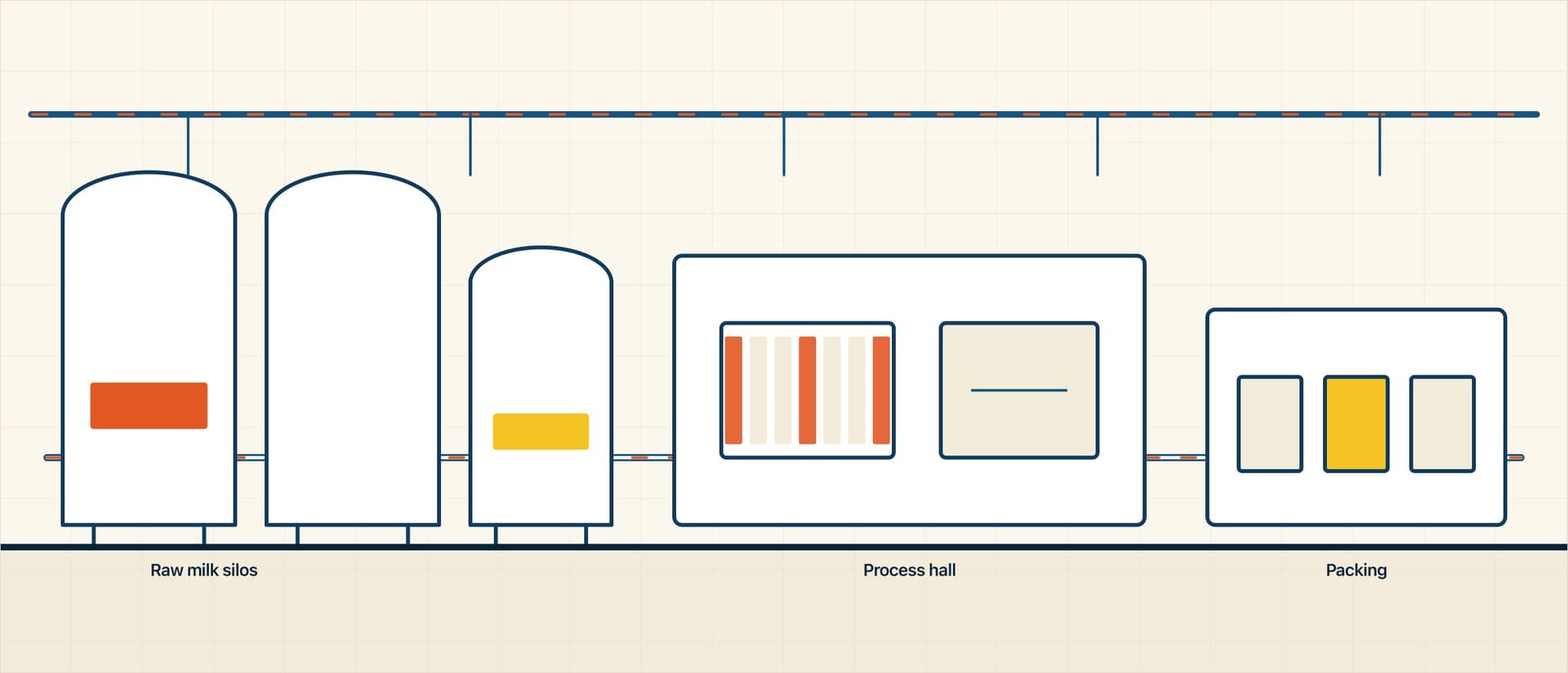
Reception and chilling
- Road milk tanker unloading pump and air eliminator
- Weighing scale or electromagnetic flow meter with totaliser
- Duplex filter and plate chiller
- Insulated horizontal or vertical raw milk silos
Processing
- Plate heat exchanger pasteuriser with regeneration above 90%
- Two-stage homogeniser
- Cream separator and standardisation skid
- Balance tank, hot water set and holding tube
Packing and utilities
- Form-fill-seal pouch packing machines with crate conveyors
- Ammonia or glycol refrigeration with PHE and ice bank
- Steam boiler, softener and compressed air package
- Centralised CIP system with acid, alkali and hot water circuits
Standards & compliance
FSSAI licensing and product standards
Plant registration, product standards and the hygiene and sanitary schedule applicable to milk and milk products. Layout, zoning and record-keeping are designed against these from the first drawing.
BIS specifications
Indian Standard specifications for dairy equipment and milk products are used as the baseline for equipment purchase specifications where a relevant standard exists. [VERIFY] Confirm current standard numbers and editions with your QA.
3-A sanitary design
Equipment design, surface finish, drainability and cleanability follow 3-A sanitary principles, which is what most institutional and export buyers audit against.
Process piping and electrical
Process piping designed to recognised pressure-piping practice; electrical installation to the applicable Indian electricity rules, with the earthing and protection scheme documented.
Effluent consent
ETP sized against the measured effluent load and designed to the discharge limits set by the State Pollution Control Board consent for your site.
Regulatory limits and standard numbers are confirmed against the current published text for your product and licence category at DPR stage.
Frequently asked
For a 50,000 LPD liquid milk plant on a cleared site, budget 10 to 14 months: about 6 to 8 weeks for the DPR and process design, 8 to 10 weeks for civil work running in parallel with equipment manufacture, 10 to 16 weeks for equipment delivery, and 6 to 10 weeks for erection, trials and commissioning. Imported equipment and monsoon civil work are the two variables that usually stretch this.
Lenders and NABARD-linked schemes typically look for milk procurement feasibility with a village-level milk shed survey, product-wise capacity and realisation, itemised capital cost supported by budgetary quotations, means of finance, projected profitability for 7 to 10 years, DSCR, break-even in both value and volume terms, and a sensitivity analysis on procurement price and capacity utilisation.
We are engineering-led, not equipment-led. We write the specification, run the techno-commercial evaluation and inspect at works, but you retain the purchase relationship with the fabricator. That keeps the comparison honest and keeps the capital cost transparent.
Yes. We start with a gap audit against the original process intent: what has been ordered, what has been erected, where the layout has drifted from the drawings and what that will cost in throughput or CIP effectiveness. You get a written recovery plan with the sequence and cost of correction before we commit to execution.
Planning a turnkey dairy projects project?
Send us the capacity, the product basket and the site location. We will tell you what the engineering actually involves before anyone quotes you for equipment.